

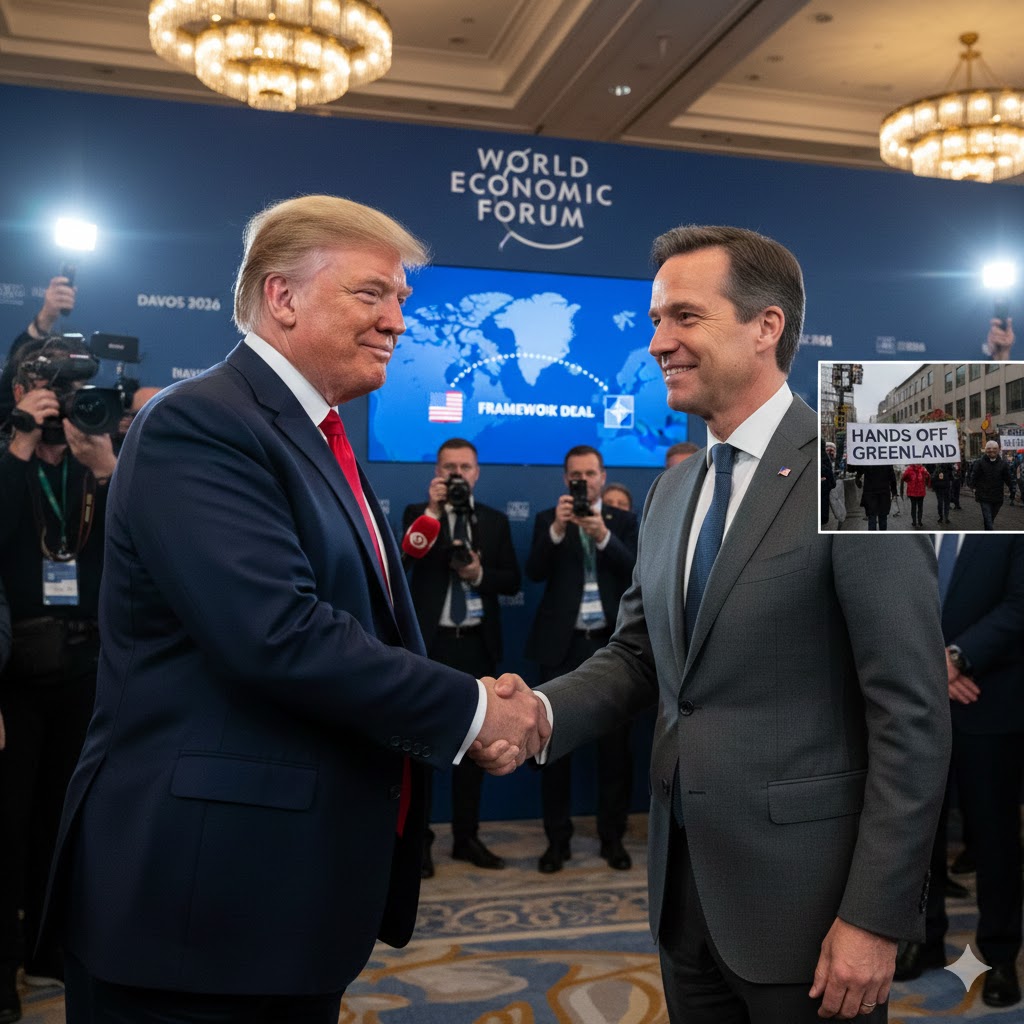

Global Tensions Ease as Trump Announces “Framework Deal” for Greenland at Davos 2026
The geopolitical storm centered on the world’s largest island has taken a dramatic turn. After weeks of escalating threats and a looming trade war, U.S. President Donald Trump announced on January 22, 2026, that a “framework of a future deal” has been reached regarding Greenland and the broader Arctic region.
The announcement came following a high-stakes meeting with NATO Secretary-General Mark Rutte during the World Economic Forum (WEF) in Davos, Switzerland.
The “Greenland Crisis” of 2026: A Quick Timeline
- January 9: President Trump states the U.S. will “do something on Greenland whether they like it or not,” suggesting a “hard way” if a deal isn’t reached.
- January 17: The U.S. threatens a 10% tariff (rising to 25% by June) on eight European nations—including Denmark, the UK, and Germany—unless they agree to the sale of Greenland.
- January 20: “Hands off Greenland” protests erupt in Nuuk and Copenhagen.
- January 21-22: In Davos, Trump rules out military force and reaches a diplomatic “concept of a deal” with NATO leadership.
What is the “Framework Deal”?
While specifics remain thin, the new framework has successfully averted an immediate economic catastrophe. Key highlights include:
- Tariff Withdrawal: Trump has suspended the proposed 10% tariffs on European allies that were set to begin on February 1.
- Enhanced Arctic Security: NATO will reportedly ramp up its security presence in the Arctic, integrating Greenland into the “Golden Dome” missile defense shield.
- Mineral Cooperation: The deal emphasizes joint development of Greenland’s vast rare earth mineral reserves, aimed at reducing global reliance on China.
Why Does the U.S. Want Greenland?
The interest is driven by two main factors: Security and Science. Geologically, recent studies confirm that Greenland sits firmly on the North American tectonic plate, a point Trump supporters have used to argue its “natural” belonging to the U.S.
Furthermore, as Arctic ice melts due to climate change, new shipping routes are opening, and previously inaccessible minerals—essential for electric vehicles and defense tech—are becoming reachable.
The Response from Denmark and Greenland
Despite Trump’s optimistic “concept of a deal,” Greenlandic Premier Jens-Frederik Nielsen and Danish Prime Minister Mette Frederiksen have been firm: “Greenland is not for sale.” Local leaders clarify that any “deal” refers to existing 1951 defense treaties and mineral cooperation, not a transfer of sovereignty. The residents of Nuuk remain anxious, with many viewing the U.S. pressure as a form of “modern-day colonialism.”