

HISTORIC SWEET SPOT — MAHAYUTI TRIUMPHS IN BMC
In a powerful political shift in Mumbai and across urban Maharashtra, the Bharatiya Janata Party (BJP) and its ally Shiv Sena (Eknath Shinde faction) — together known as the Mahayuti — secured a decisive victory in the 2026 Brihanmumbai Municipal Corporation elections, reshaping the civic political landscape and altering the balance of power in one of India’s most pivotal civic bodies.
The Brihanmumbai Municipal Corporation (BMC) — often described as India’s richest and most influential local body — has 227 seats. Historically dominated for decades by the erstwhile undivided Shiv Sena, the 2026 elections marked a major turning point.
Final Results: A Clear Mandate
- BJP emerged as the single largest party in the BMC, winning 89 seats.
- Shiv Sena (Shinde-led) allied with the BJP secured 29 seats.
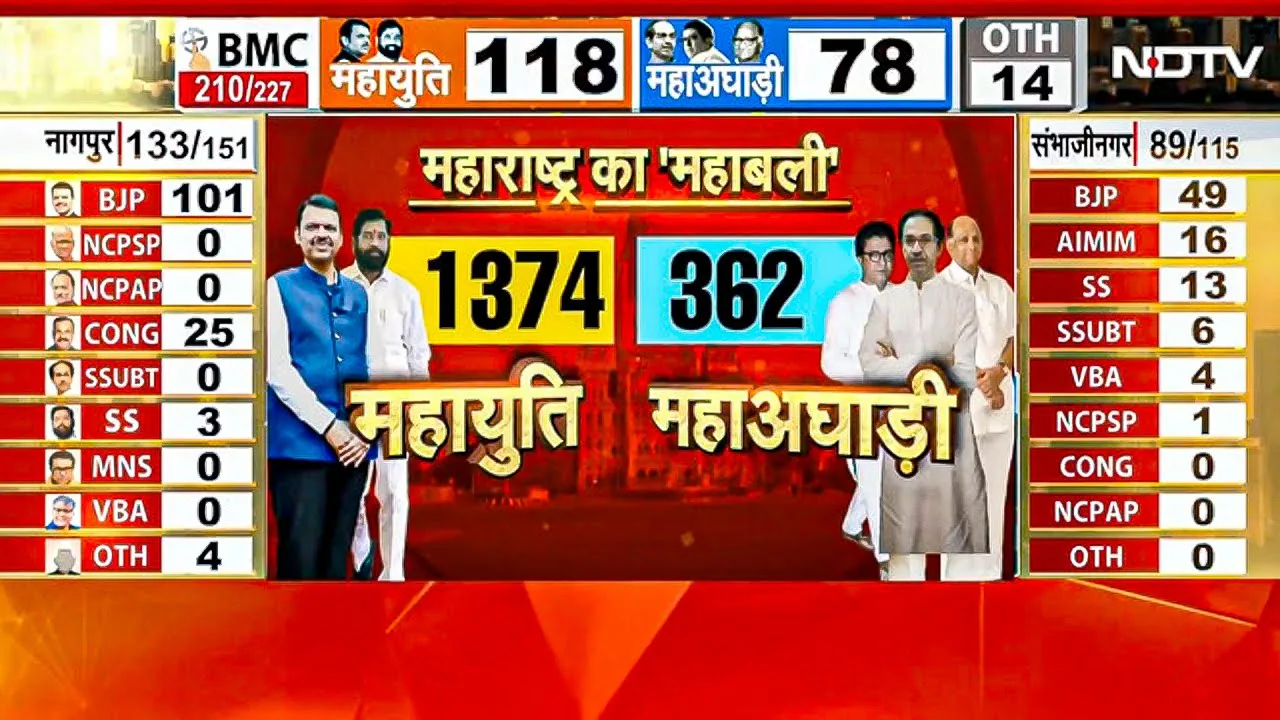
- Together, the Mahayuti alliance surpassed the majority mark (114) with 118 seats.
- The Uddhav Thackeray-led Shiv Sena (UBT) finished with 65 seats, while the Congress, AIMIM, MNS, and NCP factions lagged further behind.
This sweeping mandate not only marked a new era in Mumbai civic politics but also established the Mahayuti as the dominant urban force in Maharashtra’s governance matrix, delivering a blow to legacy parties and reaffirming BJP’s electoral strength across multiple municipal bodies.
BEYOND BMC — STATEWIDE CIVIC SWEEP
The BJP-Shiv Sena alliance did not just win in Mumbai — they swept the Maharashtra municipal elections in many urban centers:
- Pune Municipal Corporation
- Pimpri-Chinchwad
- Navi Mumbai
- Nagpur
- Thane
- Mira-Bhayandar
- Nashik
- Solapur
and several others saw the Mahayuti emerge as the principal political force, often by comfortable margins.
Overall across the state, the BJP alone won over 1,400 seats across municipal corporations, an unprecedented performance that underscored the party’s penetration in urban Maharashtra — far beyond its traditional base.
WHY THIS MATTERED: BREAKING OLD PATTERNS
Ending Three Decades of Sena Dominance
For nearly 30 years, the undivided Shiv Sena — under leaders like Bal Thackeray, Uddhav Thackeray and later the splintered factions — had wielded influence in the BMC. The 2026 results broke that long-standing hold and established a new political order in India’s richest civic body.
BJP’s Strategic Gains
The BJP’s performance went beyond a mere alliance win. The party emerged as the single largest force in BMC for the first time on its own credentials, reflecting strong organizational work, targeted campaigning, and strategic voter outreach.
Political analysts highlighted several reasons for the BJP’s dominance:
- Urban development narrative and governance claims
- Appeal to diverse demographic groups
- Triple engine effect — alignment between municipal, state, and central government agendas
- Fragmented opposition allowing multi-cornered contests to benefit the Mahayuti coalition.
THE CAMPAIGN — ISSUES, STRATEGIES, AND NARRATIVES
Mahayuti’s Pitch
The Mahayuti alliance’s campaign focused heavily on:
- Urban infrastructure and civic services
- Public safety and law-and-order
- Economic opportunity and investment
- Efficient governance and clean administration
Senior leaders, including Devendra Fadnavis (Maharashtra Deputy Chief Minister) and other BJP stalwarts, argued that voters were choosing delivery over legacy politics, often invoking improved infrastructure and service delivery as key reasons for their surge.
The alliance also projected itself as a unified force capable of addressing pressing municipal concerns — from traffic and waste management to housing and public health — contrasting this with what they described as stagnation under old guard leadership.
The Opposition’s Struggles
The Uddhav Thackeray faction of the Shiv Sena — and its occasional allies like Congress and smaller parties — struggled to consolidate votes in a way that could overcome the Mahayuti’s electoral strength. The opposition’s fragmented stance and differing messages diluted their impact, especially in multi-cornered contests.
VOICES FROM THE GROUND — REACTIONS AND ANALYSIS
Political Analysts
Experts described the outcome as a recalibration of Maharashtra’s urban political map, with the Mahayuti exploit strategies that blended political consolidation with governance promises. The results were also seen as reinforcing the “triple engine” narrative where voters preferred ideological and administrative coherence between municipal, state, and central leadership.
Party Leaderships
- BJP leaders celebrated the verdict as a mandate for governance and development, crediting hard ground-level work over years and a positive voter response to their civic agenda.
- Eknath Shinde, representing Shiv Sena allied with BJP, highlighted that the citizens had put faith in the Mahayuti and that the alliance would honor that trust with proactive governance.
Opposition Perspectives
Opposition leaders, including from the Uddhav Thackeray camp, expressed disappointment, citing larger political currents and campaign inequalities, but also hinted at internal evaluation and future strategy planning. Analysts observed that while opposition forces retain meaningful presence, they need a more unified and resonant narrative to counter the Mahayuti’s momentum in future contests.
IMMEDIATE AFTERMATH: GOVERNANCE AND MEYORSHIP
With the Mahayuti alliance controlling the majority of seats:
- The Mayor’s post in Mumbai became a focal point of political negotiation, with signals pointing toward leadership from within the alliance.
- Administrative reorganization was already underway inside the BMC headquarters, including reallocation of party offices and refurbishments reflective of the new political control.
- Policymakers immediately prioritized urban development projects and administrative continuity to signal efficiency and stability to residents.
WIDER IMPLICATIONS — WHAT THIS MEANS FOR MAHARASHTRA POLITICS
Shift in Urban Power Dynamics
The Mahayuti’s sweeping performance signals a fundamental shift in Maharashtra’s urban political equations, particularly in:
- Policy priorities
- Resource deployment
- Future electoral strategies
The BMC win provides the Mahayuti coalition with control of major urban resources and governance levers, which will be politically significant in upcoming state and national elections.
Opposition Recalibration
Parties that underperformed face pressing decisions about alliances, leadership and messaging. For the Uddhav Thackeray faction of the Shiv Sena and the Congress, the challenge will be reinventing their appeal to attract broad-based urban voters who increasingly appear aligned with development-oriented frames.
CITIZENS’ RESPONSE — PUBLIC SENTIMENT
Voters’ reactions varied:
- Many expressed support for promises of improved city services and stronger civic governance.
- Others saw the results as affirmation of political efficiency and alignment with broader national priorities.
- Some raised concerns about political monopolization and healthy democratic competition, calling for vibrant opposition voices.
Public discourse highlighted that while administrative performance mattered, identity narratives, governance messaging, and coalition dynamics equally shaped voting behavior.
LOOKING FORWARD: WHAT COMES NEXT
Over the coming months, the Mahayuti alliance is expected to set its civic agenda into motion, focusing on:
- Infrastructure modernization
- Urban planning
- Affordable housing
- Public amenities enhancement
Their performance in governance will become a litmus test for maintaining political strength ahead of future elections.
Conversely, opposition parties will likely reassess strategies to break new ground in civic and state politics.
CONCLUSION
The 2026 BMC election results represent one of the most significant political realignments in Maharashtra’s recent history. The BJP-Shiv Sena Mahayuti’s triumphant victory, particularly the BJP’s emergence as the largest single party in BMC, reflects deep electoral currents influenced by governance aspirations, alliance dynamics, and shifting voter preferences. Drawing from historical dominance, strategic alliances, and clear majority outcomes, this election will be studied as a pivotal moment in the evolution of civic politics in India’s urban heartland.